

YouTube turned 20 last year. It has been part of the internet’s infrastructure for so long that it can feel like a given. That familiarity might pose a problem for advertisers.
In fact, YouTube’s audience reach and user loyalty are running significantly ahead of the attention it receives from marketers. And advertisers could be leaving opportunity on the table.
The Audience Numbers
YouTube commands a big audience, but it might surprise you just how strong its reach is.
According to eMarketer’s 2026 forecast, YouTube Shorts alone (just the short-form video feature within YouTube) has more US users than any other social platform in its entirety, reaching 198.7 million Americans. YouTube’s total US viewer base reaches 255.4 million, a figure that exceeds Facebook, Instagram, TikTok, and every other platform measured.

YouTube Shorts
Now, here’s a data point that really might surprise you: Sensor Tower’s 2026 State of Mobile report says that YouTube is the top app in the US by share of audience across every age group, for both men and women. No other app can claim that kind of demographic sweep.
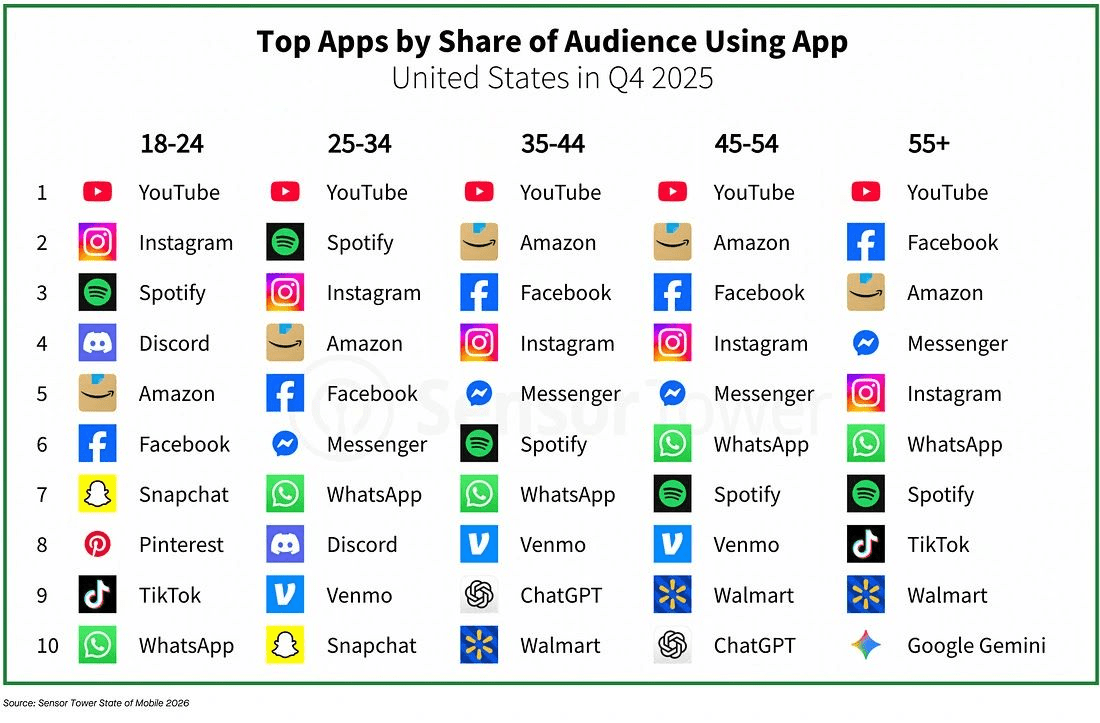
YouTube Data
And YouTube leads not just in reach but in durability. A Harris Poll cited by eMarketer found that only 5% of Gen Zers say they are cutting back on YouTube, compared to 12% who say the same for both Instagram and TikTok. And 38% of Gen Zers plan to use YouTube more, a higher share than for any other social platform. In a competitive landscape where Gen Z loyalty is the most contested resource in media, YouTube is winning.
But . . . Do Advertisers Get It?
Despite that commanding audience position, Sensor Tower found that YouTube’s share of mobile user acquisition ad spend (the budgets that app marketers allocate to social platforms to drive installs) dropped to approximately 12% in 2025. That puts YouTube roughly level with a declining TikTok, while Meta’s platforms captured a combined 69% share. In other words, the platform with the widest US audience is not attracting ad investment proportional to that reach, at least among mobile performance marketers.
The pattern on the organic social side appears similar. According to eMarketer, social media teams have not gotten serious enough about YouTube, observing that “even though there’s a lot of momentum and interest in YouTube from social media marketers, actual approaches vary quite a bit.”
Three Reasons Advertisers Underestimate YouTube
So, what’s going on here? I believe three factors are at work:
YouTube’s Own Identity Works Against It
The platform has positioned itself in regulatory and public contexts as a video streaming service and content distribution platform rather than a social network. That positioning shapes how marketers categorize and budget for it. When YouTube sits in the streaming column rather than the social column, it competes for different dollars against different benchmarks, and often gets less strategic attention from the social teams responsible for creator and content programs.
YouTube’s hybrid Nature Creates Operational Complexity
Unlike Instagram or TikTok, YouTube functions simultaneously as a social platform, a search engine, and a streaming service. Sessions on YouTube often begin with a specific search query rather than a passive scroll. Well-performing videos run 7 to 15 minutes. More than one billion hours of YouTube content are watched on television screens every day. Each of those characteristics requires a different content strategy, measurement framework, and team skillset than the platforms that consume most of social media teams’ bandwidth.
Short-Form Video Saturation Has Set In
The Proliferation of Short-Form Video Across TikTok, Instagram Reels, and now LinkedIn has fragmented marketer attention and budget across an expanding set of platforms. Meanwhile, all YouTube’s foundational audience advantages have remained largely constant. The newer platforms have pulled focus without diminishing YouTube’s underlying reach.
What This Means for Advertisers
The Sprout Social 2025 Impact of Social Media Report found that 68% of marketing leaders say YouTube drives the most business impact of any platform. If that’s true, the Sensor Tower data suggests that advertisers might be over indexing on other platforms at the expense of YouTube.
YouTube’s audience breadth is not in dispute. Its cross-demographic dominance, the Gen Z loyalty data, and the continued explosive growth of Shorts all point toward a platform whose strategic value is easier to acknowledge than to operationalize. Advertisers can get a leg up on the competition by stop treating YouTube as a permanent given and start to treat it as an active priority.
True Interactive works with advertisers to build effective programs across YouTube and the broader digital landscape. If you are looking to get more from your YouTube investment, we would be glad to talk.
Photo source: Photo by BoliviaInteligente on Unsplash
